
You want dry food to land on schedule, stay fresh, and fit the way your home actually runs. That matters most on long workdays, early commutes, and weekends away, where a messy bowl routine turns into a small daily hassle. The right feeder keeps portions predictable without asking for much attention. Some models lean simple, while others add app control, cameras, or dual power for a little more peace of mind.
The Shortlist At A Glance

Sarpaws FW1 Cat Feeder and Water Dispenser

Petmagic Gravity Cat Feeder 3.6L

oneisall Automatic Cat Feeder 3.5L WiFi
PETKIT Automatic Cat Feeder with Camera

PETKIT Automatic Cat Dog Feeder with Camera

IMIPAW PET Automatic Cat Feeder 3L

oneisall Automatic Cat Feeder 3L
Bsemax Automatic Wet Food Cat Feeder

MUBBI Automatic Cat Feeder 7L
More Details On Our Top Picks
The FW1 makes sense for homes that want feeding and hydration handled in one footprint. The locking lid and desiccant bag matter because dry food stays a little more protected from humidity, while the 10-second voice recorder adds a familiar cue for cats that like routine.
Wire or battery power gives you a useful backup path, especially in rooms where outlets are awkward. Four daily meals suit cats that do better with smaller servings, though the trade-off is that this is less about app convenience and more about dependable basics.
Strong Points
- Combines food and water in one station, which keeps the feeding area tidier.
- Programmable portion control helps you keep meals more consistent through the day.
- Battery backup adds peace of mind in rooms without an easy plug location.
- The voice recording can help your cat recognize mealtime from day to day.
Things To Consider
- It leans more toward straightforward scheduling than app-based control.
- The combined setup takes more counter or floor space than a single-bowl feeder.
- Food and water both need regular cleaning, so upkeep is a little more involved.
Core Details
Who It Suits Best
Busy households that want a simple feeder and water station in one setup will get the most out of this model.
Where A Sibling Pick Shines
oneisall Automatic Cat Feeder 3.5L WiFi fits better for you when app control and feeding logs matter more than a built-in water dispenser.
This Petmagic set stays simple, and that’s the point. A gravity feeder uses the food level itself to keep the bowl topped up, so it works well in low-drama homes where you want less programming and fewer moving parts. The 45-degree outlet is there to help food flow more smoothly, while the desiccant in the food bin gives dry kibble a better shot at staying crisp.
The two-piece layout is easy to place and easy to understand, which makes it a good first step for kittens, small dogs, or anyone easing into automatic feeding. The trade-off is obvious too, because gravity systems do not give you the meal-by-meal control that the Sarpaws FW1 or oneisall WiFi feeder can offer.
What We Like
- Gravity-fed design keeps the setup straightforward and low effort.
- The sloped outlet helps reduce food hang-ups in the dispenser.
- Two separate pieces make placement easier around a kitchen or feeding corner.
- Desiccant support helps dry food stay in better shape between refills.
Small Caveats
- You do not get timed portions, so feeding control stays basic.
- It takes a bit more floor or counter space than a single bowl.
- Gravity feeding suits steady eaters more than pets that need measured meals.
Feature Snapshot
Right Fit For
Apartment dwellers and first-time feeder shoppers who want something simple and low-maintenance will appreciate this setup.
Look Elsewhere When
oneisall Automatic Cat Feeder 3.5L WiFi suits you better once you want app-based scheduling, feeding logs, and a more exact routine.
This one is built for the person who wants more control without jumping into a camera-heavy setup. The app gives you timed meals, feeding logs, and a feed-now option, so the routine feels closer to a planned schedule than a basic hopper. The stainless steel bowl is a useful touch for cleanup, and the dual power backup helps keep the feeder practical in real homes where outlets and outages are never perfectly convenient.
Family share support is handy in households where more than one person handles feeding, though the 2.4G connection means your home network setup needs to match that band. Compared with the Petmagic gravity feeder, this model asks for a little more setup but gives you far more control over timing and portions.
Upsides
- App control makes scheduling easier than buttons alone.
- Feeding logs help you keep track of mealtime patterns.
- Precise portion control suits cats that need smaller servings.
- Dual power backup adds flexibility for everyday placement.
- Stainless steel bowl is easier to wipe down than many plastic parts.
Points To Note
- WiFi setup adds a little more setup time than a basic feeder.
- 2.4G network support means your router settings matter.
- The feature set is richer, so the learning curve is a bit higher.
Details At A Glance
Best Suited To
Tech-comfortable households that want exact scheduling and a clearer feeding history will get the most value here.
Swap It Out When
PETKIT Automatic Cat Feeder with Camera fits better for you once remote visual check-ins matter as much as scheduling.
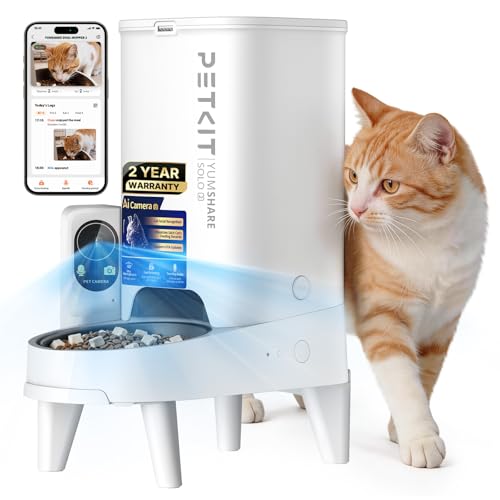
Once you want to see the feeding area, the PETKIT camera model makes the category feel much more connected. The 1080P HD video and night vision matter in dim rooms or late evenings, while two-way audio and meal call features add a bit of interaction that basic feeders cannot offer. Motion capturing gives the camera a more active role than the oneisall WiFi model, so you can check what happened around the bowl instead of guessing.
There is still a practical side to think about, because camera-equipped feeders ask for more attention to app settings and privacy preferences. That said, the desiccant bag keeps the dry-food side grounded, and for households that want to keep an eye on a pet from another room, the extra layer feels very useful.
Highlights
- Camera view helps you check feeding activity from a distance.
- Night vision supports lower-light rooms and evening check-ins.
- Two-way audio adds a simple way to talk back.
- Meal call makes scheduled feeding feel more familiar for pets.
- Motion capturing gives you a stronger sense of bowl activity.
Worth Noting
- The camera features add setup choices that plain feeders avoid.
- You will likely spend more time adjusting app preferences.
- The feature stack makes this more suited to tech-friendly homes.
Spec Overview
Who Will Love This
Households that travel often or want visual check-ins on a cat from another room will get the most from this feeder.
A Better Fit Elsewhere
oneisall Automatic Cat Feeder 3.5L WiFi suits you better when you want app control without paying for a camera-focused setup.
This version takes the camera idea a step further, but the real twist is control. You can set the camera’s operating window and turn voice recording on or off through the app, which makes it feel more considerate for households that do not want a camera running all the time. The side indicator light also gives you a plain visual cue, so you are not left guessing about camera status.
Compared with the PETKIT camera feeder above, this one feels more privacy-aware and a little more deliberate in how it handles monitoring. The dual hopper design also hints at broader food handling flexibility, though the source details focus more on camera controls than on bowl mechanics.
Bright Spots
- App-based camera scheduling gives you tighter control over monitoring.
- Voice recording can be switched on or off from the app.
- Indicator light provides a simple on-off status at a glance.
- Dual hopper design offers more flexibility than a single-bin layout.
Room For Improvement
- The camera-focused feature set may feel more involved than basic feeders.
- You will probably spend more time deciding which app options to leave active.
- The source details focus less on meal mechanics than on privacy and imaging.
Core Details
Built With In Mind
Privacy-conscious households that still want camera access and app control will find the balance appealing.
Reach For A Different Pick When
PETKIT Automatic Cat Feeder with Camera is the better match for you if you want camera monitoring first and a simpler privacy setup second.
IMIPAW keeps the formula plain in a good way. You get timed feeding, up to six meals, and portion settings from 1 to 20, so the feeder can handle pets that do better with smaller, measured servings. The desiccant bag helps protect dry food in the hopper, and the easy-clean design matters in a kitchen where cleanup already has enough chores attached to it.
Compared with the WiFi oneisall, this model skips the app layer and puts more of the focus on direct programming. That makes it a solid match for you if you want a dependable countertop feeder without extra setup friction.
Positives
- Six-meal programming gives you decent schedule flexibility.
- Portion control from 1 to 20 supports smaller servings.
- Easy-clean construction lowers the effort of routine upkeep.
- Desiccant support helps keep kibble in better shape between refills.
Areas To Watch
- You do not get WiFi or app-based control.
- The feature set is simpler than the higher-end camera feeders.
- Manual setup may feel less convenient for shared households.
Technical Sheet
Perfect Match For
Households that want portion control and a clean, simple setup without app features will feel comfortable with this feeder.
Another Choice May Suit
oneisall Automatic Cat Feeder 3.5L WiFi suits you better when you want feeding logs, remote setup, and app access.
This version is aimed at dry food that does not always come in tiny pellets. Large kibble and snack-style pieces are the point here, so it serves a practical niche for homes that have food shapes other feeders can struggle with. The 12-cup, 3L capacity is comfortable for routine use, and the corded design keeps power simple rather than asking you to manage batteries.
That said, it is less about advanced scheduling than about compatibility and consistency. Compared with the app-driven oneisall WiFi model, this one feels more direct, which is useful when you care more about food size than phone control.
Best Bits
- Handles larger kibble and snack-style dry food.
- 3L storage gives you a solid everyday reserve.
- Corded power avoids battery juggling.
- Programmable feeding keeps mealtime predictable.
Minor Gripes
- The feature set is simpler than the WiFi version from the same brand.
- It is focused on dry food, so it does not cover mixed feeding needs.
- Corded power limits placement to spots near an outlet.
Feature Rundown
The Right Fit
Homes feeding cats that prefer larger dry pieces will get more value from this feeder than from a general-purpose hopper.
Where A Sibling Pick Shines
oneisall Automatic Cat Feeder 3.5L WiFi suits you better once you want app control and feeding logs alongside the same brand’s basic reliability.
This is the outlier in the list, because it shifts from dry food to wet food with refrigeration support. The two ice packs and timed four-meal layout make sense for homes that want fresh servings spaced through the day, especially for cats that do not eat the same way a dry-only feeder expects. It is also the kind of setup that asks for more attention to cleaning and storage than the dry-food models above.
Compared with the simpler gravity and programmable dry-food feeders, this one is more specialized and less universal. That specialization is exactly why it stands out, but it also means it belongs in a smaller set of homes with the right routine.
What We Like
- Refrigerated design suits fresh wet food service.
- Two ice packs support temperature management between meals.
- Timed four-meal format fits a structured day.
- Works for small pets as well as cats and dogs.
Honest Caveats
- Wet food setups demand more cleaning than dry-food bins.
- Specialized use makes it less versatile than the other feeders here.
- You will want a consistent routine for refilling and washing.
Core Details
Whose Shelf It Belongs On
Homes that feed wet food on a schedule and do not mind extra cleanup will get the most from this specialized feeder.
Skip It When
MUBBI Automatic Cat Feeder 7L is the better fit for you if dry food, larger capacity, and longer gaps between refills matter more.
The MUBBI feeder is the one to notice when a bigger hopper matters more than extra app features. Seven liters gives you a generous dry-food reserve, and the 1 to 6 meal range lets you stretch feeding across the day without constant top-ups. The desiccant bag helps keep moisture under control, which matters even more in humid kitchens or apartments with less airflow.
Dual power supply is the practical part that rounds it out, because it gives you flexibility in where you place it and how you keep it running. Compared with the 3L IMIPAW and oneisall models, this one is the better fit for longer refill gaps and slightly larger feeding routines.
Reasons To Buy
- Large 7L capacity reduces refill frequency.
- Six-meal programming supports a controlled dry-food schedule.
- Dual power supply gives you more placement flexibility.
- Desiccant support helps protect dry food in storage.
- Fits 2 to 15 mm dry food, which helps with broader kibble compatibility.
Softer Spots
- The larger body takes more room than the smaller 3L feeders.
- It stays focused on dry food, so wet-food homes need a different model.
- More capacity can mean less frequent checks, which still should not replace routine cleaning.
Feature Card
Best Suited To
Households that want a larger dry-food feeder with fewer refill interruptions will appreciate this model most.
Where A Sibling Pick Shines
IMIPAW PET Automatic Cat Feeder 3L suits you better when countertop space matters more than a bigger food reserve.
How To Choose The Right Auto Cat Feeders For Dry Food
Match The Feeder To Your Daily Routine
The best fit usually starts with your schedule, not the gadget list. A feeder with simple timed meals works well for steady routines, while app control makes more sense for travel days, shared caregiving, or mornings that start before sunrise.
Capacity matters for the same reason. A 3L unit suits smaller households and tighter counters, while a 7L hopper is better when you want fewer refills and a little more breathing room between top-offs.
Look Closely At Food Handling
Dry food is not all the same size, so kibble compatibility matters more than people expect. Models that mention larger kibble or a wider dry-food range are more likely to handle mixed shapes without jamming or awkward flow.
Moisture control also counts. A locking lid, desiccant bag, or enclosed hopper helps protect dry food in humid kitchens, though none of that removes the need for regular cleaning.
Think About Control, Not Just Capacity
Portion control is useful for pets that do better with smaller servings through the day. Simple button-based programming is enough for many homes, but feeding logs, feed-now controls, and family sharing add convenience once more than one person handles meals.
Camera features belong to a narrower group. They suit you best when check-ins matter, but they also add app settings, privacy choices, and more upkeep than a plain feeder.
Choose The Simplest Setup That Solves The Problem
A gravity feeder is easy to live with, yet it gives up portion precision. A programmable feeder brings better routine control, while a wet-food model is for homes that specifically need chilled servings rather than dry kibble.
The honest read is that the most expensive unit is not always the best fit. It just solves a more specific problem, and that is often the part worth paying for.
Things Worth Knowing First
Common Shopping Slip Ups
Many people focus on capacity and forget the food type. Large hoppers do not help much if the feeder cannot handle your kibble size or your feeding style.
Another common miss is choosing more features than you will use. A camera and app are useful in the right home, but they add setup and maintenance that some kitchens do not need.
What The Higher Tier Buys
Higher-tier models usually spend more on connectivity, sensors, cameras, and app features. That extra hardware gives you better visibility into feeding patterns and more ways to control the routine from outside the house.
The upgrade makes the most sense for homes with uneven schedules, multiple caretakers, or a real need to check the bowl from afar. For a basic daily routine, a simpler timed feeder can still do the job neatly.
Frequently Asked Questions
Are automatic cat feeders good for dry food only?
Most feeders in this roundup are built for dry kibble and similar dry pieces. The wet-food model is the exception and uses refrigeration support instead of a standard hopper.
How much capacity should you choose?
Three liters works well for smaller spaces and shorter refill cycles. Seven liters suits you better when you want fewer top-offs and more food reserve.
Do WiFi feeders need special setup?
Most WiFi models use the 2.4G band, so router settings matter. That extra setup usually buys you remote scheduling, logs, and app-based adjustments.
Is a camera feeder worth it?
Camera feeders make sense when remote check-ins matter to your routine. They are less compelling for homes that only need timed portions and nothing more.
What should you clean most often?
The bowl, hopper, and any moisture-control parts deserve regular attention. Wet-food feeders usually need the most frequent cleaning because of the food type itself.
Closing Thoughts
The best feeder for your home is the one that matches your food type, schedule, and tolerance for upkeep. A simple gravity set works for easy routines, a WiFi feeder helps when control matters, and a camera model earns its place only when visibility is part of the job. Larger hoppers reduce refill chores, but smaller units often fit better on real counters. Choose the one that fits the way you already live, and the routine gets easier fast.