
You want a feeder that fits your routine, not one that adds chores. The right automatic dry cat food dispenser helps with early mornings, late shifts, travel days, and the small chaos of a cat who starts asking for dinner before you’ve even set the table.
Some options focus on basic timed portions, while others add WiFi, cameras, or larger hoppers for less refilling. This roundup keeps the differences clear so you can match the dispenser to your space, your schedule, and how involved you want to be.
The Shortlist At A Glance

Sarpaws FW1 Automatic Cat Feeder and Water Dispenser

oneisall Automatic Cat Feeder 2.4G WiFi 3.5L
PETKIT Automatic Cat Feeder with Camera 1080P HD

PETKIT Automatic Cat Dog Feeder with Camera

IMIPAW PET Automatic Cat Feeder 3L

oneisall Automatic Cat Feeder for Large Kibble and Snacks 3L
Bsemax Automatic Wet Food Cat Feeder

MUBBI Automatic Cat Feeder 7L 29 Cups

PAWGETHER Gravity Cat Feeder 3.5L
More Details On Our Top Picks
Sarpaws goes for utility first, and that makes sense for busy homes that want feeding and watering in one setup. The locking lid and desiccant bag help the dry-food side stay protected, while the programmable portion control and four daily meals keep the routine straightforward.
The 10-second voice recorder is a small but useful touch for cats that respond to familiar sounds. Wire-or-battery flexibility helps during power changes, though the compact, do-it-all format also means you’ll want to keep up with cleaning and refill checks.
What We Like
- Combines food and water management in one footprint.
- Portion control helps you shape a steadier routine.
- Four daily meals suit predictable schedules.
- Voice recording can make meal time feel familiar.
- Dual power options suit rooms with awkward outlet placement.
Things To Consider
- The combined design takes a bit more countertop space than a plain feeder.
- The water side adds another part to clean and maintain.
- Battery use means you’ll want to stay mindful of charge or replacement planning.
Core Details
Who It Suits Best
Households that want a straightforward feeder-and-waterer setup in one unit will get the most from this design.
Where Another Pick Suits Better
oneisall Automatic Cat Feeder 2.4G WiFi 3.5L suits app-focused commuters who want feeding logs and remote control rather than a combo setup.
Where Sarpaws keeps things simple, this oneisall model leans into app control. Timed meals, feed-now control, feeding logs, slow-feed mode, precise portions, and family sharing give you a lot of flexibility for a cat that needs a tighter routine.
The stainless-steel bowl is a practical touch for everyday cleanup, and the dual power backup helps in homes that worry about interruptions. That said, the app-heavy setup suits people who want more control, not shoppers who prefer a plain dial-and-go feeder.
Reasons To Buy
- WiFi control makes meal scheduling easier from away from home.
- Feeding logs help you keep track of daily patterns.
- Slow-feed mode can suit cats that rush meals.
- Family sharing helps more than one person manage the routine.
- Stainless-steel bowl is easier to keep tidy than many plastic bowls.
Points To Note
- The app features add setup steps compared with a basic timer feeder.
- WiFi-dependent functions suit a stable 2.4G home network best.
- Some households may not need the log and sharing tools at all.
Feature Rundown
Who Will Love This
Tech-comfortable cat owners who want app scheduling and detailed feeding oversight will get the most out of this feeder.
Another Choice May Suit
IMIPAW PET Automatic Cat Feeder 3L suits you better when you want a simpler, lower-friction setup without app tools.
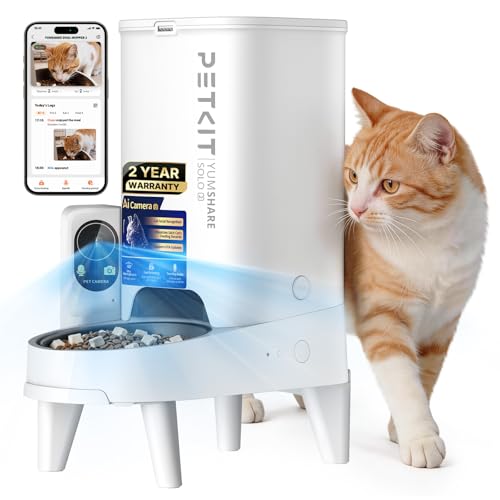
This PETKIT model stands out for homes that want to see more than just a bowl level. The 1080P HD camera, night vision, two-way audio, meal call, and motion capture make it a stronger fit for checking in on a cat during workdays or short trips.
Compared with the simpler oneisall feeder, this adds real oversight, but that also means more to think about during setup and privacy settings. For a person who likes a visual check-in, the feature mix feels thoughtful rather than gimmicky.
Highlights
- Camera access helps you check the feeding area from afar.
- Night vision supports low-light viewing in the evening.
- Two-way audio lets you speak through the unit.
- Motion capture adds another layer of activity awareness.
- Desiccant support helps protect dry food in the hopper.
Worth Noting
- The camera features create more setup decisions than a plain feeder.
- Video and audio tools make the unit less minimal for small spaces.
- Owners usually want to keep an eye on app permissions and camera settings.
Feature Snapshot
Built With In Mind
Cat owners who want camera access alongside timed feeding will find this one especially useful.
Look Elsewhere When
MUBBI Automatic Cat Feeder 7L 29 Cups makes more sense for you when storage size matters more than camera features.
This PETKIT version goes a step further on privacy control, which matters more than people expect once a camera enters the room. The app lets you set camera active hours and toggle voice recording, and the side indicator light gives a visible cue for the camera state.
Compared with the camera-focused model above, this one leans more into control and privacy management. That makes it a better fit for homes where the feeder sits in a shared living space or near a work desk, though you’ll still be paying for features not every cat household needs.
Upsides
- Camera timing controls help you manage privacy more closely.
- Voice recording can be turned on or off in the app.
- Indicator light makes the camera state easier to see.
- Dual hopper setup supports more organized food separation.
Small Caveats
- The feature set is richer than most basic feeders, so setup takes more attention.
- Camera-based control is more than some homes actually need.
- Dual-hopper hardware usually means more parts to keep clean.
Details At A Glance
The Right Fit
This suits you best when camera access and privacy control matter just as much as feeding automation.
Where A Sibling Pick Shines
oneisall Automatic Cat Feeder 2.4G WiFi 3.5L is the better match for app-heavy scheduling without the camera hardware.
IMIPAW keeps the feature mix lean, which is exactly why it makes sense for a lot of first-time feeder setups. The 3L capacity, six-meal program, and 1 to 20 portion range give you enough control to manage a simple routine without making the setup feel fussy.
The desiccant bag is a nice inclusion for dry food storage, and the easy-clean, easy-setup angle matters more than flashy extras in many kitchens. It sits in a sweet spot for shoppers who want something understandable the first day it arrives, not a mini command center.
Best Bits
- Six-meal programming gives you clear routine control.
- Portion range from 1 to 20 helps fine-tune serving size.
- 3L capacity suits smaller spaces and moderate refill intervals.
- Simple setup is helpful for a first automatic feeder.
- Desiccant support helps maintain kibble quality between fills.
Honest Caveats
- The smaller capacity will need refills sooner than larger hoppers.
- It focuses on basics, so feature hunters may want more control.
- Cleaning still matters, especially around the food path and bowl.
Core Details
Whose Shelf It Belongs On
New feeder users and small-space households will appreciate the straightforward layout here.
Skip It When
MUBBI Automatic Cat Feeder 7L 29 Cups is the stronger choice for you when larger storage matters more than a compact footprint.
This oneisall feeder earns its spot by handling larger kibble and snacks, which is the kind of detail that matters more than glossy extras. For households with chunkier dry food or mixed kibble shapes, that compatibility can save a lot of frustration at mealtime.
It’s corded, so placement planning matters more than with battery-based options like Sarpaws FW1. The upside is a cleaner, simpler power setup for a fixed feeding corner, though you’ll want to keep the food path clear and the bin clean in the same way you would with any dry dispenser.
Strong Points
- Handles large kibble and snack pieces better than many basic feeders.
- 3L size keeps the unit compact without feeling tiny.
- Corded power suits a permanent spot near an outlet.
- Useful for mixed dry-food shapes that can jam smaller dispensers.
Areas To Watch
- Cord placement matters more than on battery-capable units.
- Three-liter storage is modest for multiple-cat households.
- The design is specialized, so it’s less appealing for small standard kibble alone.
Feature Card
Perfect Match For
Cat owners using larger dry pieces or snack-style kibble will get the most from this feeder.
A Better Fit Elsewhere
Sarpaws FW1 Automatic Cat Feeder and Water Dispenser suits you better when you want battery flexibility and an attached water solution.
Wet-food feeders are a different category altogether, and this Bsemax model is built around that reality. The refrigerated design with two ice packs is the key detail here, since it supports timed wet meals instead of dry kibble service.
That makes it a strong fit for households that rely on chilled food portions and need a machine that accounts for the food’s texture. The trade-off is simple: you gain freshness support and lose the simplicity of a dry-only feeder, so cleanup and loading planning matter more.
Bright Spots
- Refrigerated design suits wet-food routines better than dry-only dispensers.
- Two ice packs add a practical cooling layer.
- Timed meal setup helps portion out meals through the day.
- Useful for homes that need a wet-food feeding structure.
Room For Improvement
- Wet-food storage means more cleanup than dry kibble models.
- The cooling approach requires more loading attention.
- It does not serve the same use case as a standard dry feeder.
Spec Overview
Who Should Grab It
Shoppers who need a timed wet-food feeder will find this far more relevant than a standard dry dispenser.
Reach For A Different Pick When
MUBBI Automatic Cat Feeder 7L 29 Cups makes more sense for dry-food households that want a larger hopper and simpler upkeep.
MUBBI focuses on storage first, and that’s useful for households that want fewer refills between fills. The 7L hopper, 29-cup capacity, desiccant bag, and support for 1 to 6 meals make it a sensible middle ground for small and medium pets.
The feeder also handles dry food sizes between 2 mm and 15 mm, which gives it broader kibble compatibility than some smaller units. Dual power supply adds placement freedom, though the larger body makes more sense on a stable counter or floor spot than in a cramped corner.
Positives
- Large hopper reduces refill frequency.
- Supports a wide range of dry food sizes.
- Dual power setup helps with room placement.
- 1 to 6 meal scheduling covers most routine feeding patterns.
- Desiccant support helps maintain dry-food freshness.
Minor Gripes
- The larger shape can feel bulky in tight kitchens.
- Big capacity is helpful, though it also means more food sitting in the bin at once.
- The dry-food focus keeps it out of the wet-food conversation entirely.
Feature Rundown
Built For In Mind
This suits households that want larger capacity without stepping up into camera or app features.
Swap It Out When
IMIPAW PET Automatic Cat Feeder 3L is the leaner choice for smaller counters and simpler routines.
PAWGETHER takes the simplest route in the lineup, which can be a very good thing for everyday feeding. The gravity-fed design needs no electricity, so it works as a low-fuss refill bowl rather than a timed dispenser, and that difference matters a lot.
It suits homes that want constant access to dry food without programming meals or managing power cords. The trade-off is plain, since gravity feeders don’t meter portions the way timed units do, but for some routines that simplicity is exactly the point.
What We Like
- No power connection needed.
- Simple refill process keeps daily upkeep easy.
- 3.5L size works well for a basic dry-food station.
- Good fit for households that want a straightforward backup-style feeder.
Softer Spots
- It does not manage portions like timed feeders do.
- Gravity flow may suit some cats better than others.
- The very simplicity that helps also limits control.
Core Details
Who It Suits Best
This is a good fit for you when you want a simple gravity-fed station rather than timed automation.
Not Your Match When
oneisall Automatic Cat Feeder 2.4G WiFi 3.5L is the better fit for app control and scheduled portions.
How To Choose The Right Automatic Dry Cat Food Dispensers
Start With Your Feeding Style
Timed feeders suit households that want portions released on a schedule, while gravity models suit cats that do well with constant access. The difference sounds small, but it changes how much control you have over mealtime and how often you need to step in. For multi-cat homes, a programmed hopper often makes more sense than a bowl that simply refills itself.
Capacity matters too, because 3L feels very different from 7L in daily life. Smaller bins fit tighter counters and usually suit one-cat homes, while larger bins cut down on refill frequency for busier schedules. A bigger hopper is handy, though it also means more food sitting in one place at once.
Match Features To Your Routine
App control helps when you travel, work late, or split care between more than one person. Logs, family sharing, and feed-now controls are useful, but only when you actually want that level of oversight. A plain timer feeder is usually easier to live with for people who just want breakfast and dinner handled without extra screens.
Cameras and two-way audio add another layer, especially for cats that like reassurance or homes that want visual check-ins. Those extras are useful, but they also increase setup time and privacy decisions. You’ll usually feel the value most in a busy home, not in a quiet room where the feeder sits a few steps away.
Check The Food Path And Materials
Dry-food shape matters more than many people expect. Larger kibble, mixed snacks, and odd-shaped pieces can work poorly in narrow chutes, so the feeder has to match the food size you already buy. A stainless-steel bowl can also be easier to maintain than a basic plastic dish, especially in a daily-use kitchen.
Freshness support such as desiccant bags helps dry food hold up better between refills. That detail won’t replace proper cleaning, though, and food bins still need regular attention around the lid, chute, and bowl. A simple design is often easier to keep tidy, even when it offers fewer extras.
Things Worth Knowing First
Wrong Turns To Avoid
Shoppers often focus on capacity first and forget the size of the food itself. A large hopper won’t help much if the chute struggles with the kibble shape already in your pantry. Placement causes problems too, especially when a corded feeder lands too far from an outlet or a gravity unit sits where pets can bump it.
Another common miss is buying a feature-heavy feeder for a routine that doesn’t need it. App control, video, and logs are useful, but they add steps and setup decisions. A simpler dispenser usually feels better for everyday use than a crowded control panel.
The Upgrade Payoff
Higher-tier feeders usually cost more because they add remote control, camera hardware, backup power, or better food handling materials. You’re not just paying for the shell, you’re paying for fewer compromises in how the feeder fits your routine. That matters most when you travel often, coordinate care with another person, or want stronger visibility into mealtime.
Extra spend also tends to buy smoother everyday use, like clearer portion control or better compatibility with different kibble sizes. The upgrade is worth it when those details solve a real problem in your home. For a simple single-cat routine, a basic timed feeder can still be the smarter move.
Frequently Asked Questions
What size feeder works best for one cat?
A smaller 3L unit often fits one-cat homes well, especially when the cat eats on a steady schedule. Larger 7L models make more sense when you want fewer refills.
Do WiFi feeders help in everyday use?
WiFi helps most when you want remote scheduling, meal logs, or shared control. It adds convenience, but it also makes the setup more involved than a basic timer.
Are gravity feeders as useful as timed feeders?
Gravity feeders are simpler and need no electricity, so they work well for constant access to dry food. Timed feeders give you more portion control and are better for structured routines.
Can large kibble work in automatic feeders?
Some feeders handle larger kibble and snacks better than others, so the food size range matters a lot. A model that specifically supports bigger pieces is a safer match for chunky dry food.
Do camera feeders make sense for cat care?
Camera feeders help when you want to check feeding activity from away from home. They also bring more setup and privacy decisions than a plain dispenser.
Final Thoughts
You have a wide spread of options here, from simple gravity feeding to app-based camera models. The right choice depends less on hype and more on how your cat eats, how often you leave home, and how much control you want over portions. For most homes, a feeder that matches the kibble size and your real routine will feel better than one packed with extras you never use. Pick the model that removes friction from your day, and the rest tends to fall into place.